

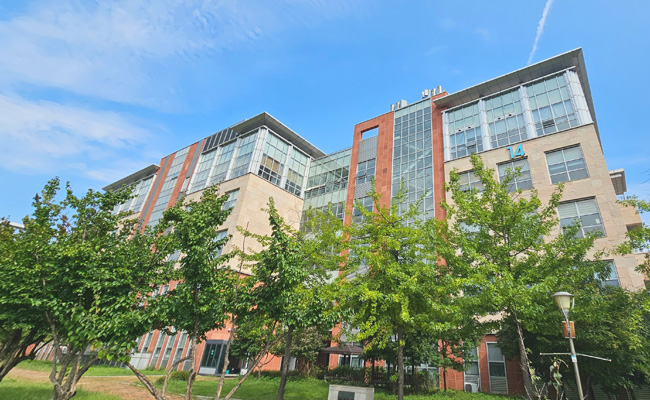
School of Northeast Asian Studies
In the era of convergence, the School of Northeast Asian International Trade is making a new start as the School of Northeast Asian Studies through its integration with the Department of Smart Logistics Engineering.
The School of Northeast Asian Studies (SONAS) consists of the International Commerce and Asian Studies Major, the Smart Logistics Engineering Major, and the International Business Economics (IBE) Major, which is exclusively for international students.
-
TEL 032-835-8710 , 8933
-
FAX 032-835-0784
-
LOCATION Room 323, Building 14
Introduction
The School of Northeast Asian Studies aims to cultivate Northeast Asian trade specialists and smart logistics professionals who can respond rapidly to changes in the global trade and logistics environment. Established in 1997, the former School of Northeast Asian International Trade was selected for the Ministry of Education’s regional university specialization initiative. Since then, it has established itself as one of Korea’s leading specialized programs in economics and international trade by providing education in economic and trade theory and practice, foreign languages, and the regional economies of Northeast Asia. It has also cultivated global trade professionals capable of leading the Northeast Asian era.
The world is now changing at an unprecedented pace. The Fourth Industrial Revolution, driven by e-commerce and smart logistics, is making international trade increasingly diverse and complex. At the same time, new economic blocs and trade rules are emerging as the multilateral trading system weakens. In response to these changes, the competencies required of global trade professionals are also evolving. There is a growing need for interdisciplinary experts who possess a multilayered understanding of Northeast Asian countries, can analyze big data related to trade and logistics, and understand global market supply chains.
The School of Northeast Asian Studies, consisting of the International Commerce and Asian Studies Major, the Smart Logistics Engineering Major, and the International Business Economics (IBE) Major, aims to cultivate interdisciplinary professionals capable of responding to changes in the global economic structure through an innovative educational program that integrates international commerce in Northeast Asia with smart logistics engineering. Courses offered by the International Commerce and Asian Studies Major and the Smart Logistics Engineering Major are shared between the two majors, and an interdisciplinary track comprising courses from both fields will be established. The School of Northeast Asian Studies will take a new leap forward into a new era.
History
-
2024
- The former Northeast Asian Commerce Major was reorganized as the International Commerce and Asian Studies Major.
- The former Korean Commerce Major was reorganized as the International Business Economics (IBE) Major.
- The Smart Logistics Engineering Major was established.r
-
2016
- Reorganized as an independent school
- The existing four majors were consolidated into the Northeast Asian Commerce Major.
- The Korean Commerce Major was established.
-
2005
- The College of Northeast Asian International Commerce was integrated into the College of Northeast Asian Economics and Commerce.
- The former College of Northeast Asian International Commerce was reorganized as the School of Northeast Asian International Commerce.
- The Departments of Economics and International Trade, formerly under the College of Commerce and Economics, were transferred to the College of Northeast Asian Economics and Commerce.
-
1997
- The College of Northeast Asian International Commerce was established.
Mission and Educational Goals
The School of Northeast Asian International Trade and Logistics aims to cultivate interdisciplinary professionals equipped with a comprehensive understanding of global trade, regional studies, and smart logistics technologies. In response to the rapidly changing global trade environment and policies, the School offers a curriculum designed to foster a new generation of convergence-oriented experts. In particular, to meet the growing demand for big data-based market analysis and the advancement of global logistics, students may choose from a variety of specialized tracks that integrate economics with data analysis and smart logistics.